A new generation of antifouling coatings promises better protection for running gear.
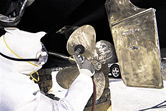
Photo: Jerry Wyszatycki
I once read a quote
mistakenly attributed to Henry Ford: “Never invest your money in
anything that eats or needs painting.” The actual author was a man
named Billy Rose, and while I don’t know what he did for a living,
I’ll bet that he painted boats in South Florida.
This region is undoubtedly
one of the toughest environments for keeping paint on running gear. Not
only are the microorganism counts higher due to warmer water, but many
boats in the 40-foot-plus range spend a fair amount of time sitting in
relatively static canals, the perfect environment for the growth of algae
and barnacles. All these factors add up to bad performance.
The good news is that
paint companies are addressing the problem. To get a handle on how one
such company, Interlux, has enhanced its products to help combat everything
from slime to barnacles, I spent a day at Norseman Shipbuilding, a Miami
repair yard, with Interlux’s sales representative Joe Purtell. What
I observed was how these new products are attacking one of the most intractable
of all fouling challenges: running gear.
Painting is one of boaters’
favorite do it yourself projects, and had this been a deck-painting project,
we could have left the yard out of the loop altogether. However, since
preparation is so important where metal is concerned, we arranged to have
the pros do the prep work and convinced the owner of our 41-foot Sea Ray
to do the painting. Purtell explained our strategy this way: “Sandblasting
creates the most uniform profile for optimum adhesion, and unless one
feels quite proficient with a grinder, what with props being computer-balanced
and all, I think letting the yard take the metal to bright is the best
plan.”
One of the unique aspects
of working with metal is that after you take it down, it almost instantly
begins to oxidize. Any knowledgeable repair yard will keep this in mind,
but if you decide to do the work yourself, you should immediately wipe
down the area with the company’s 216 thinner (an exceptionally strong
solvent formulated to dry rapidly) and apply one coat of 353/354 VinyLux
Primewash—that is unless you want to essentially resand the entire
project. The application is crucial. Unlike most underwater paints where
thicker is better, this hard, self-etching primer must be put on thin
enough that you can see through it, so reduce it by 25 percent with the
proper Thinner. (Etching provides the chemical and physical bond for the
primer; without it, the primer and paint will flake off.)
This article originally appeared in the March 2004 issue of Power & Motoryacht magazine.