Here’s an ad that made me nostalgic for the Roaring Twenties. Wasp was a 46-foot motor-yacht designed and built in 1923 by Henry C. Grebe. During the first half of the 20th century, a Grebe yacht was one of the finest built in the U.S., up there with Trumpy, Consolidated, Elco, and Huckins. Powered by a pair of 200-horsepower Sterling Petrels—the best engines you could buy—Wasp could run at 27 mph wide-open. (On inland waters, where Wasp flew, they measure speed in mph, not knots.) That was a pretty good top speed for a boat like this back then; she probably cruised in the high teens.
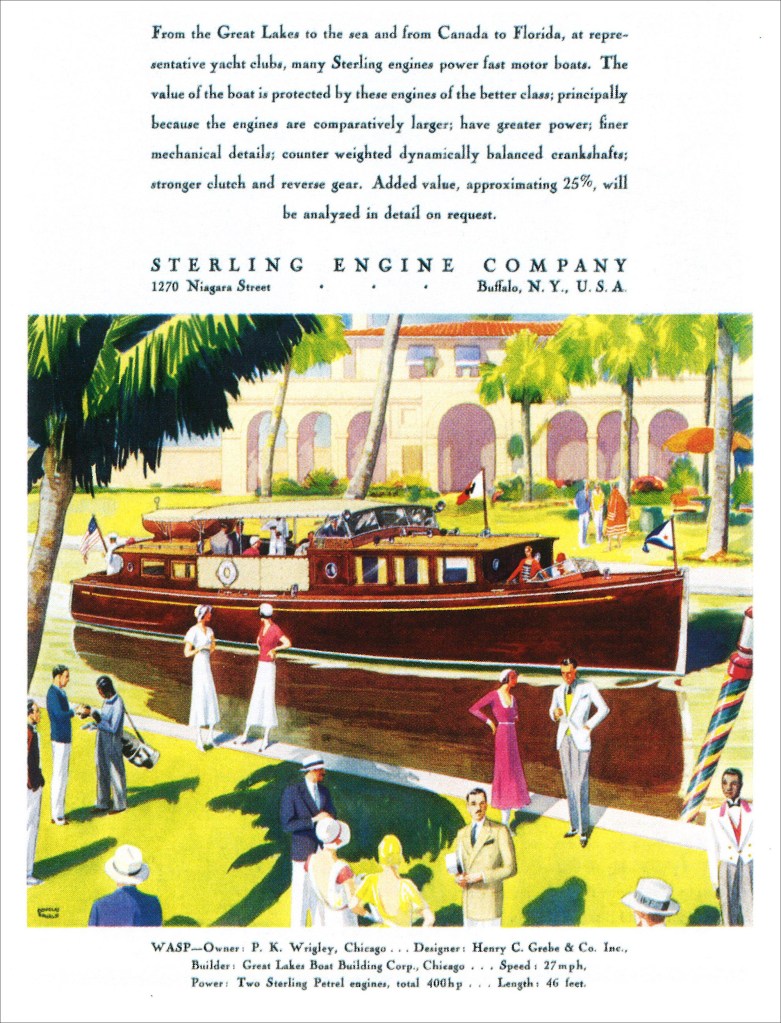
Grebe design and build, Sterling power—what else did it take? Oh, maybe some cash: Even 100 years ago, custom yachts didn’t come cheap. But the owner of Wasp, Philip K. Wrigley, had all he needed, and then some: Wrigley’s father, William Wrigley, Jr., gave us chewing gum, the Chicago Cubs, and Wrigley Field. Philip—P.K. to his friends—worked with his father and eventually took over the leadership of the business. P.K. was an avid yachtsman: He kept Wasp at his home outside of Chicago and, on nice days, commuted aboard her to his office downtown. Later, he owned at least one other Grebe yacht, an 88-footer also named Wasp.
Sterling built bigger engines than the Petrel, and Wrigley had plenty of cash to pay for them, so why didn’t Wasp have more than just 400 horses? That seems kind of wimpy for a yacht this size; today, cruisers of similar length and performance carry at least twice as much power. But modern hulls aren’t as easily driven as the light, narrow, low-deadrise hulls of a century ago, and Waspwas a dayboat; she didn’t carry the extensive accommodations and myriad onboard systems of today, which add lots of weight and demand more horsepower.
But not everything aboard Wasp was light: The in-line six-cylinder Sterling Petrel engines displaced 779 c.i.d., with a 5.25-inch bore by 6-inch stroke. The cylinder was almost big enough to hold an old-fashioned 39-ounce coffee can. There were two independent ignition systems with two spark plugs in each cylinder to ensure even combustion, and to provide redundancy in case one system headed south while at sea. The Petrels weighed 1,520 pounds each, twice as much as a modern 200-horsepower marine gasoline engine. Like all Sterling engines, they were strongly built for durability, longevity, and reliability. The advertisement above isn’t lying: Sterlings were great motors. And some of them are still running today, a century later.
This article originally appeared in the August/September 2026 issue of Power & Motoryacht magazine.