
The waterways of Vancouver are as placid as they are exotic to a native East Coaster. Cute little seals pop their heads up for breaths right next to kayakers taking in the city skyline. Bald eagles soar overhead in numbers indicating a healthy fishery. And pods of orca are known to come in absurdly close to shore, adding a surreal ripple to the urban hustle and bustle sometimes just a few feet away.
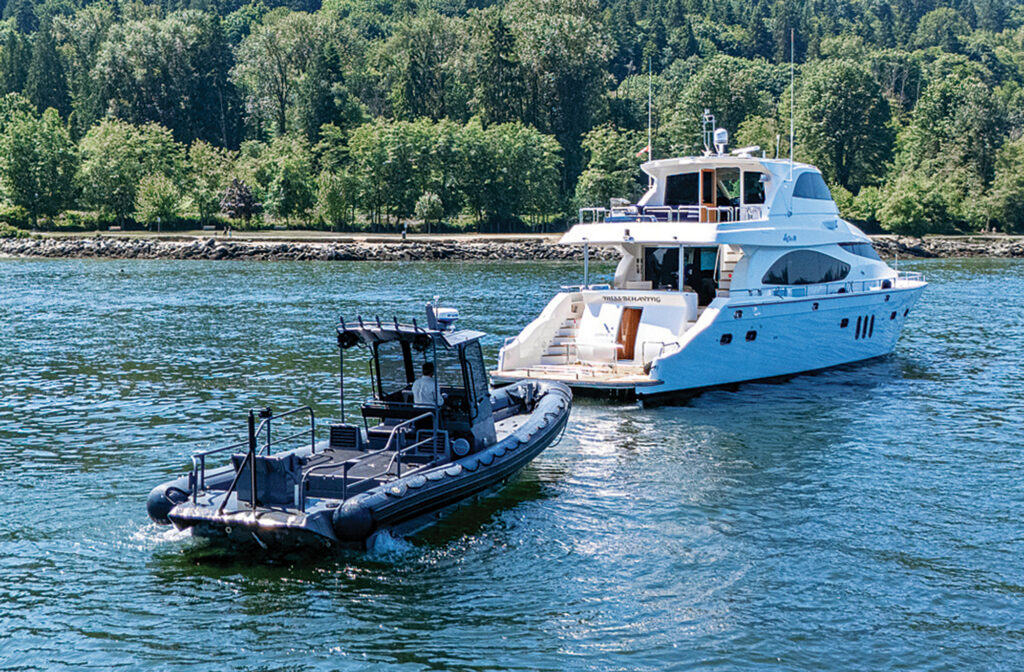
I took in all this dreamlike scenery from the USMI 36 RHIB that is currently for sale at Vancouver’s Ignition Marine. I had seen photos of the “Rigid Hull Inflatable” boat before I stepped aboard, but I realized they didn’t really do it justice as she puttered up to pick me up on a downtown dock. The USMI is a favorite of America’s most storied military group, the Navy SEALs. The SEALs’ mission is to take the fight to the enemy on sea, air, and land (hence the acronym in their name). And for this purpose, they have chosen the USMI as a favored vessel. They use the hardy little boat for insertion and extraction missions, maritime interdictions, coastal patrol and surveillance, airdrops, and medical evacuations. It is effectively their do-it-all pickup truck, and it looks the part.
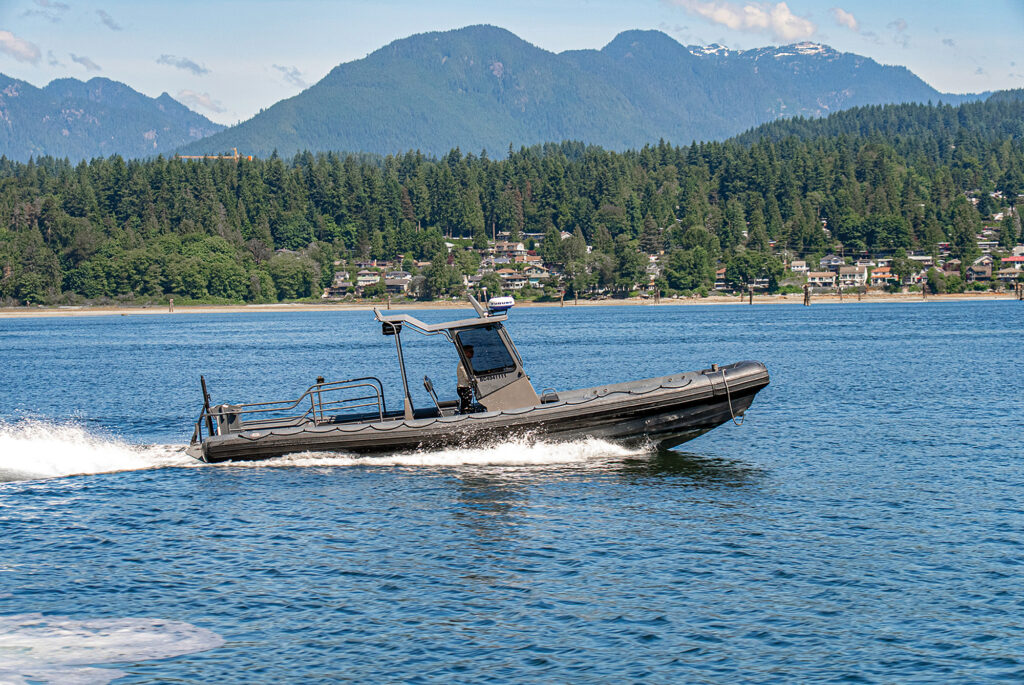
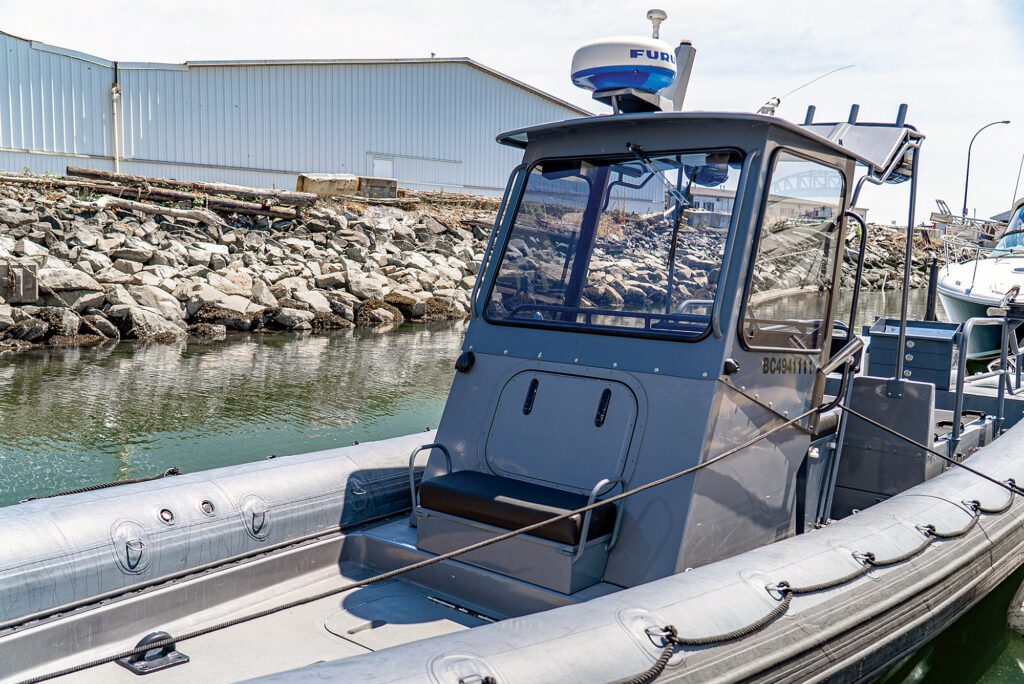
Every aesthetic aspect of this boat speaks to one single, solitary thing: kicking ass. Form follows function after all, and one glance at this pugnacious USMI is all it takes to understand that this is not your average recreational cruiser. There are no cushions, no sunpads; there isn’t even much seating. The cockpit is a flat, raised metal section meant for hauling things that spread freedom. Bolt-ons in the bow are made for helicopter hooks for airdrops. On this boat, there were single rod holders to either side of the console. They were so out of place as to look nearly comical. As if the boat was saying, “Hey guys, no need to be afraid, I can have fun too. It’s not all hand grenades and machine-gun turrets.” (The boat can handle twin .50-caliber machine guns, one at the bow and one at the stern.) Suffice it to say, no one is mistaking the USMI for a Sea Ray anytime soon.
So with gnarly aesthetics like this, and a naval-special-warfare pedigree, what was the performance like? Well, let me put it this way: I knew I was in for something when my host, Tony Lavin of Ignition Marine, dug up a line from an unseen corner of the deck and looped it around his waist. “Just in case I fall in. She turns pretty tight,” he said with a short laugh. I glanced around for my own line, which sadly did not exist. “Hang on tight with two hands to that bar,” Lavin said pointing to a handhold on the portside of the console. “You’ll be fine. With a hand on the wheel and a hand on the throttle I can get tossed around a bit.” At this point I was wondering what the hell I had gotten myself into.
Nevertheless, away we went.
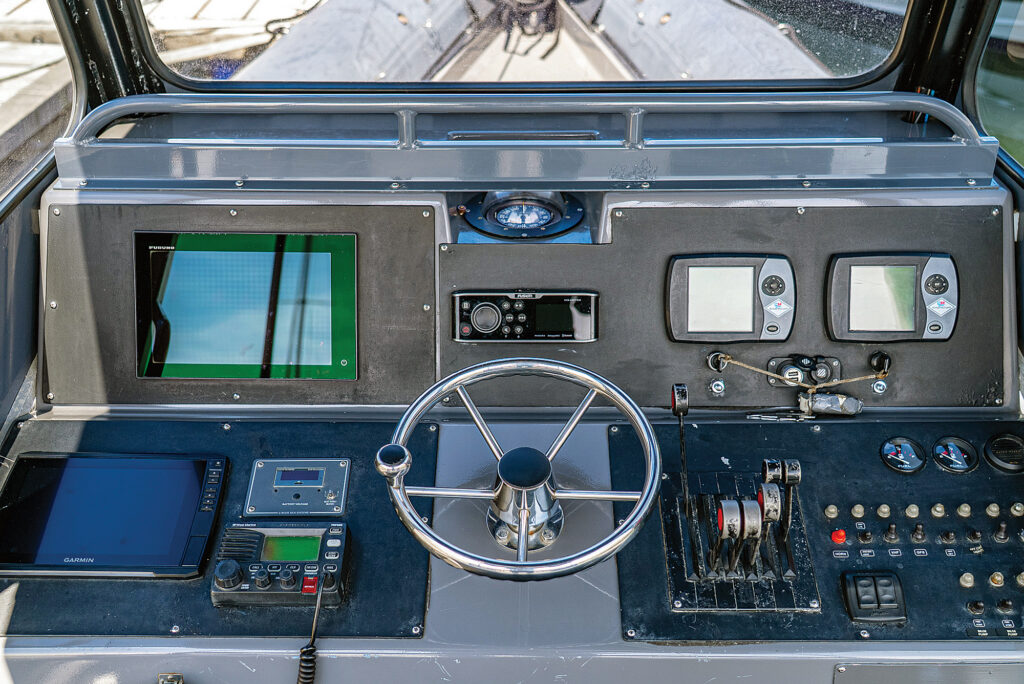
I’d estimate in my day I have completed about 500 sea trials. I’ve gone 100 knots in an MTI on the Hudson River. I’ve ripped a Cigarette Top Gun across Biscayne Bay at speeds just shy of that. And I’ve spun a Protector Targa 28 like a top in hardovers, in about half a boat length. And I can say this for certain: I have never experienced anything close to what the USMI 36 RHIB can do. Her top speed is 44 knots, and we were clocking just shy of that when we hit our first hardover turn to starboard. Although “turn” is not exactly the right term here. It felt more like a ricochet, as if the boat had hit something solid and bounced off it, and then in an instant we were heading in another direction. Then we did the same to port. I wish I could give you some visuals, like if the boat turned in her own footprint, or what the wake looked like, or even if I had been able to hold my phone up to capture the action. But all that would have been impossible. iPhone footage of the sea trial would have looked like the final scene of The Blair Witch Project. I was very happy to have two hands on that handhold.
The boat runs twin 380-horsepower Cummins 5.9L turbo diesels matched to Kongsberg Kamewa waterjets. Her Kevlar-composite hull is, as you may have guessed, bulletproof. It is hand laid, and has a lamination buildup that is heavier than what’s seen on most recreational boats. There are multiple woven layers reinforced with closed-cell foam and ballistic-resistant layers in high-stress spots. (That’s important if you find yourself under fire, but offers real peace of mind in extreme conditions as well.) The USMI was built to complete missions in winds up to 45 knots and Sea State 5 conditions, meaning waves between 13 and 20 feet tall. To say she is overbuilt is an understatement, with all components bolted and welded into place. Even as we whipped the boat around as hard as we could, nothing shook, nothing rattled, nothing rolled. Her deep-V hull design with 24 degrees of deadrise at the transom easily split the slight chop we saw, and sliced right through larger ferry wakes. At the same time her Hypalon tubes provided the added stability one expects from a RIB.
So by now you might be wondering, where exactly did this beast of a machine come from? USMI, or United States Marine, Inc., is not exactly a household name. The company was founded in 1971 in Gulfport, Mississippi, by Tom Dreyfus, who was later joined by Larry Ellis. They did not start USMI to win wars or deliver commandos to beachheads. Instead, they initially aimed for something much more quaint: winning sailboat races. They made their bones as a tech-forward builder of racing sailboats.
“The company was founded by my dad,” says current CEO Barry Dreyfus Jr. “We had some early successes in some big races but let’s say he found the sailboat industry a little fickle. He wanted steady work and nothing was steadier than working for the U.S. government. He had some relationships that helped him get teamed up. We did one-off projects for the military for years, but we got our first steady government contract in 1988, and that set the company off growth-wise.”
Dreyfus reacts with a chuckle when asked how his boats compare to recreational boats. “Listen, they can call Sea Tow to get them out of a tough spot, the Navy SEALs can’t,” he says. “We need to build our boats to make sure they will always be able to get our guys home no matter what. And I’ll tell you another thing, if you buy this boat, it will last forever.”
As for the boat’s rather singular performance, and particularly its turning ability, Dreyfus points to no less than Jimmy Buffett himself. “Back when Jimmy was having sea trials done on his Rybovich [the 42-foot Last Mango II] we used the RHIB as a chase boat. Me and Jimmy were on it and he was at the wheel. He made some turns, and I won’t say what I actually said to him, but I kind of let him know that he could be turning a little more aggressively. So, he whipped it around and we must have hit about 4G, and he has this smile about a mile wide on his face. He told me he was going to fly me upside down in his airplane next.”
So, for a boat dripping with this much machismo, and with performance so outside of the box, where does the USMI 36 RHIB fit into the market, and who buys it? The real answer is, it’s its own market. It’s currently the only RHIB of its kind for sale to recreational boaters in the world. And the person who buys it is the same kind of person who has a car collection that includes a demilitarized Abrams tank. This is a boat that is truly one of one, and its future ownership will most certainly reflect that.
And as for this sea trial, in a career full of colorful memories, this one will go down as one of the most impossible to forget. The USMI 36 RHIB is just as tough and adventure-prone as the men she was built to carry.
USMI 36 RHIB Specifications:
LOA: 36’
Beam: 10’
Draft: 2’
Displ.: 12,000 lb.
Fuel: 250 gal.
Cruise Speed:
32 knots
Top Speed: 44 knots
Power: 2/380-hp Cummins QSB 5.9L
Price: $176,000
This article originally appeared in the January 2026 issue of Power & Motoryacht magazine.