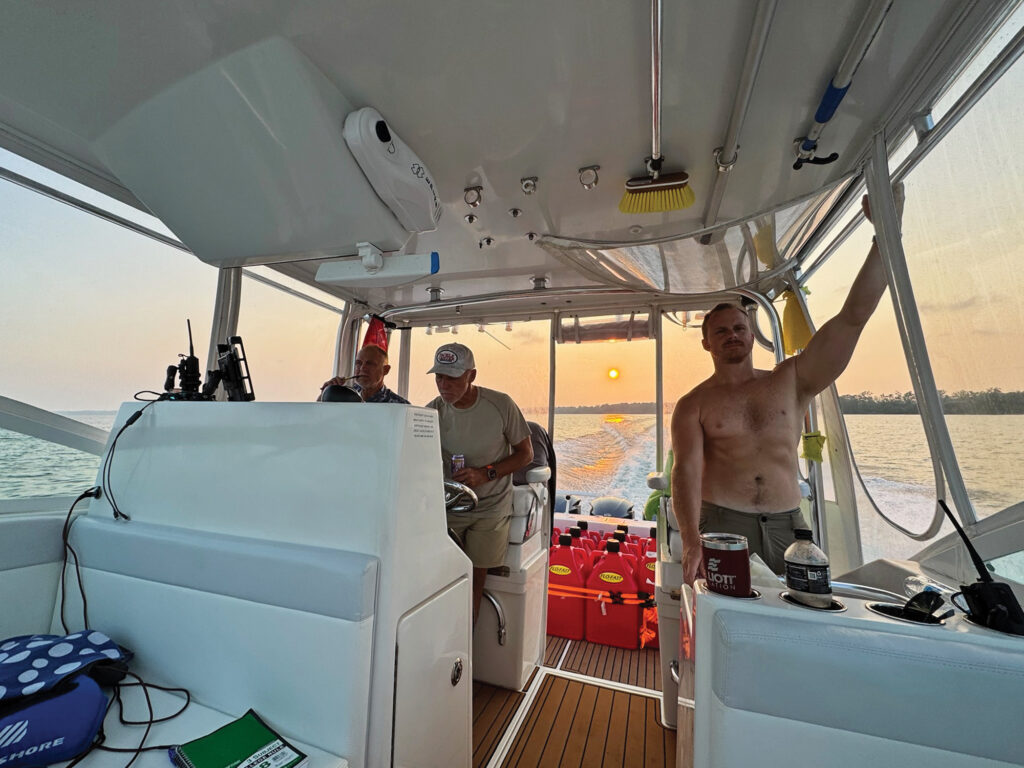
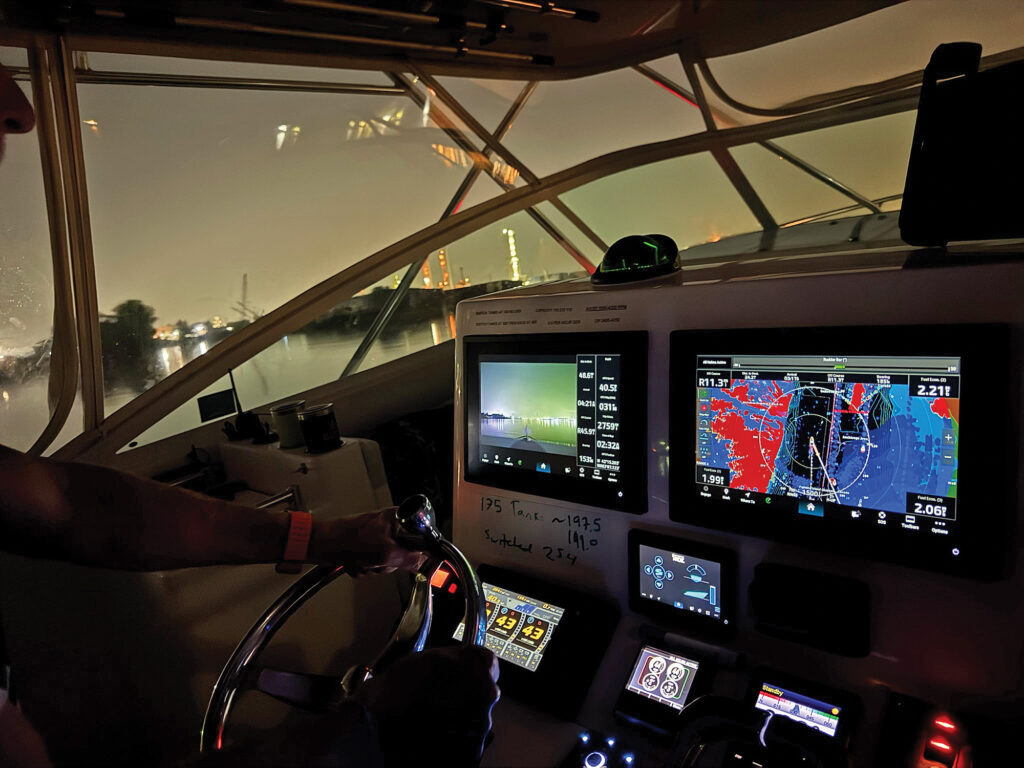
At 3:17 in the morning, somewhere between exhaustion and delirium, Peter Hajas found himself laughing. Not the kind of laugh that comes from hearing a good joke, but the odd, hiccupping chuckle of a man who’s been awake too long and knows the absurdity of what he’s doing. His sons—bleary-eyed, jaws slack with fatigue—were slumped against the cabin bulkheads like crash-test dummies in life jackets. The only thing keeping their 40-foot Contender Express, Lady Lore, on course was an autopilot that Hajas prayed would hold steady. The steering wheel in front of him, gleaming stainless steel and utterly useless, might as well have been a piece of nautical wall art.
“Basically,” he later told me on the Power & Motoryacht podcast, “we drove a day and a half without a steering wheel. Literally zero steering other than the autopilot.
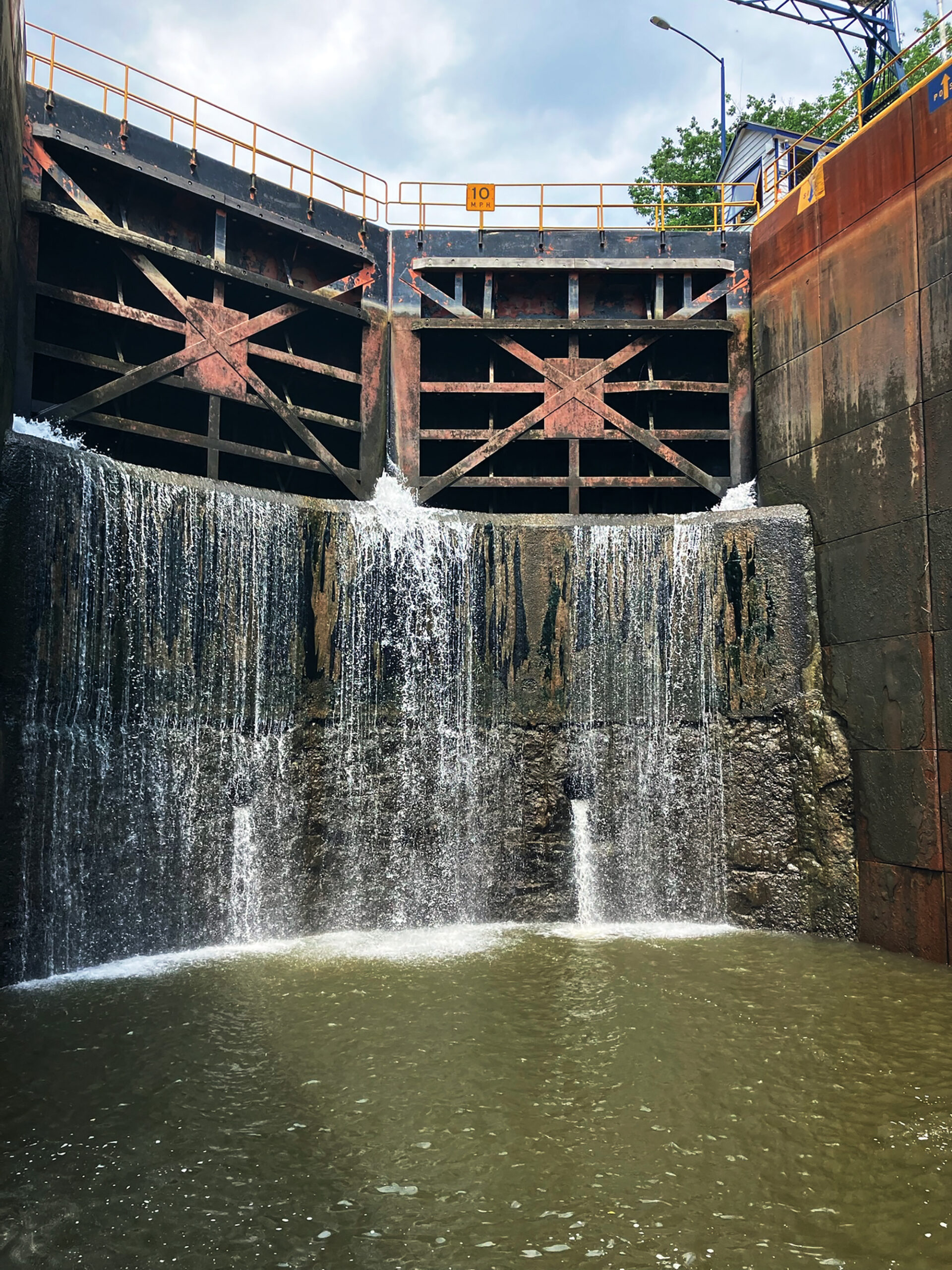
That understatement was typical of Hajas: matter-of-fact, unflappable, and not above finding the comedy in calamity. The Erie Canal wasn’t exactly where he expected the voyage to unravel, but then again, no one expects to lose steering at the start of a 6,000-mile endurance test. What you expect—if you’re reasonable—is to stop, fix the problem, maybe call it quits. What Hajas did was keep going, dialing strangers, begging for parts, and hoping his sons, one of whom was better at debugging code than helming a boat, could reprogram their way out of disaster.
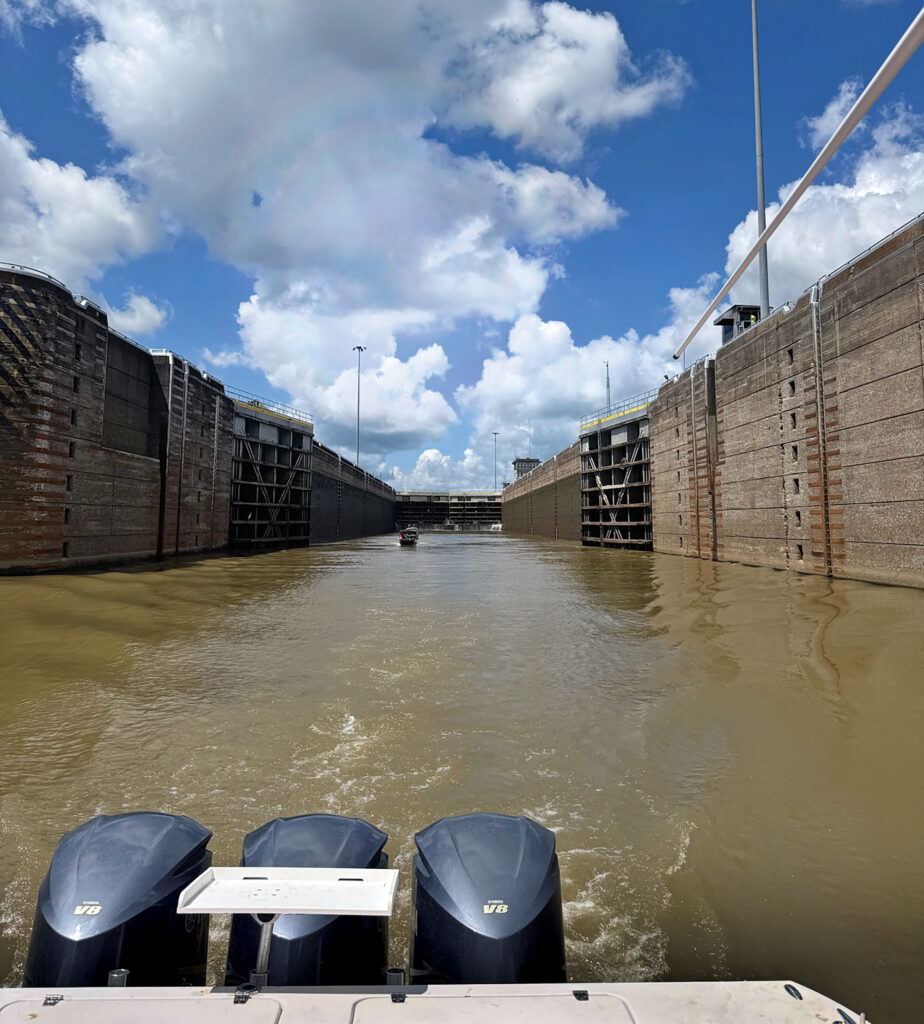
This was no weekend jaunt. This was the Great Loop—the boating equivalent of a transcontinental marathon, except instead of sneakers and Gatorade, participants burn through diesel, lock fees, and the patience of everyone aboard. It is a journey most tackle at a leisurely pace, over the course of a year or more, enjoying a thousand small harbors, historic canals, and sleepy waterfront towns. Hajas did it in 12 days, 18 hours, and 10 minutes. The phrase “record-breaking” doesn’t quite capture the lunacy of it. Imagine driving coast-to-coast across America without stopping for a hotel, surviving on gas-station snacks and catnaps. Now add currents, barges the size of apartment buildings, and steering gear that collapses like a folding chair mid-picnic.
For reasons that remain somewhere between noble and slightly deranged, this was the adventure Peter Hajas set out to chase. The motivation was equal parts family and unfinished business. His father, who had once dreamed of running the Mississippi, never got the chance. Peter, Midwestern by birth but newly settled in the Florida Keys, had been bitten by the bug late in life. He had the boat, he had two sons willing to crew, and—most dangerously—he had an itch to test himself against the clock.
“I know a lot of people take a year or two,” he said sounding almost wistful. “I think a year or two would be cool. I’d like to slow down once and try this,” he pauses. “But this time, it was about doing the trip with people I love.”
That’s how one finds himself barreling down the Tennessee River in the dead of night, kept awake by caffeine, adrenaline, and the occasional shout from a barge captain warning them to “hug the left bank or else.” That’s how a man with modest river and lake experience ends up crossing open water at speeds that would make traditional Loopers clutch their gin and tonics.
And that’s how, at 3:17 in the morning on the Erie Canal, with the steering wheel dangling as decoration, Peter Hajas laughed. Not because it was funny in any ordinary sense, but because sometimes on the water you find yourself at the intersection of terror, absurdity, and awe—and the only thing left to do is keep moving forward.
For a man who just ran the Great Loop faster than anyone in history, Peter Hajas did not come from a lineage of ocean-crossing adventurers. He grew up in the Midwest, where boating is a pastime defined by smaller ambitions: tubing behind a runabout, puttering on lakes rimmed with pine trees, easing pontoons down quiet rivers. His family’s summer home was in Wisconsin, and his father—a practical man with an impractical dream—used to daydream aloud about floating a pontoon down the Mississippi. He never got the chance.
That dream stuck. “God bless him,” Peter said on the podcast, his voice softening. “That was always in the back of my mind.”
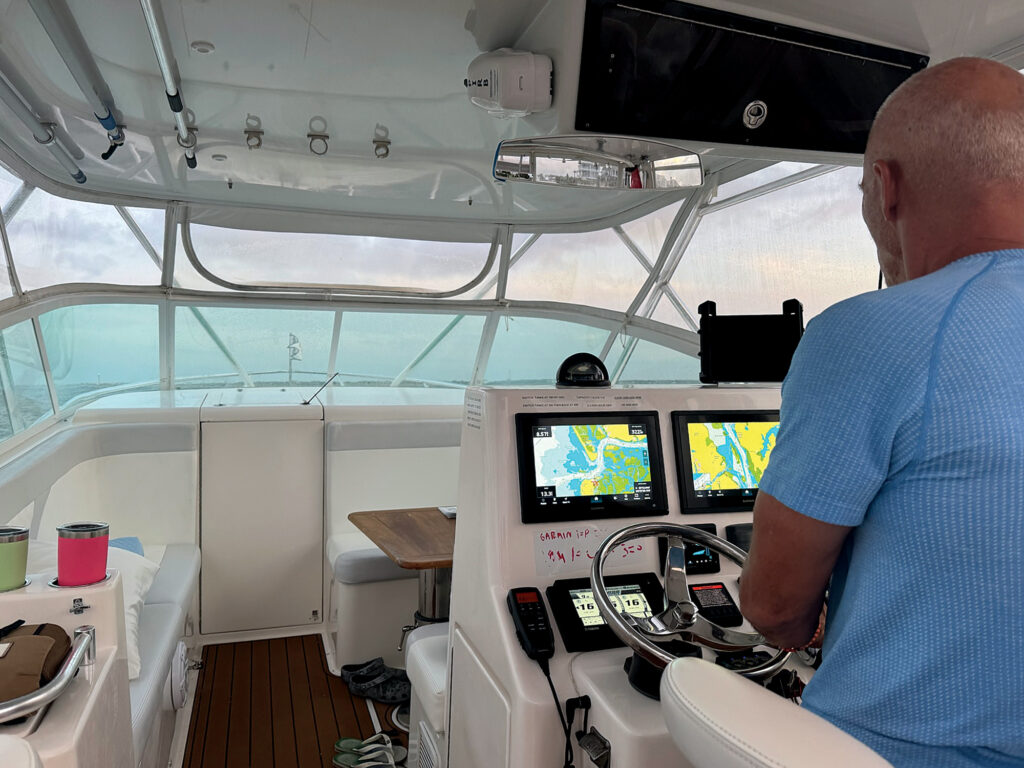
What separates fantasy from action is often a single, fateful purchase. In Peter’s case, it was a Contender 40 Express named Lady Lor. He bought her specifically for the Loop, circling ads and squinting at listings until the right one appeared. Not for the teak, or the lines, or the head-turning profile, but for her practicality: long-range tanks, speed when needed, and just enough space to shoehorn in a crew of three without ending up in maritime homicide court.
The family boat before this one had been a thirty-footer in Minnesota—big enough for waterskiing, not nearly big enough for a record attempt across North America. In fact, when Peter moved to the Florida Keys only a year and a half before his record run, his offshore résumé was thin. He had mechanical savvy, Midwestern stubbornness, and a “mini-loop” under his belt: a Keys–Okeechobee–Atlantic–Keys jaunt with his younger son that tallied a few hundred miles. Hardly the kind of apprenticeship that screams world-record contender.
But then again, audacity has always been the passport of amateur adventurers. What they lack in pedigree, they make up for in resolve.
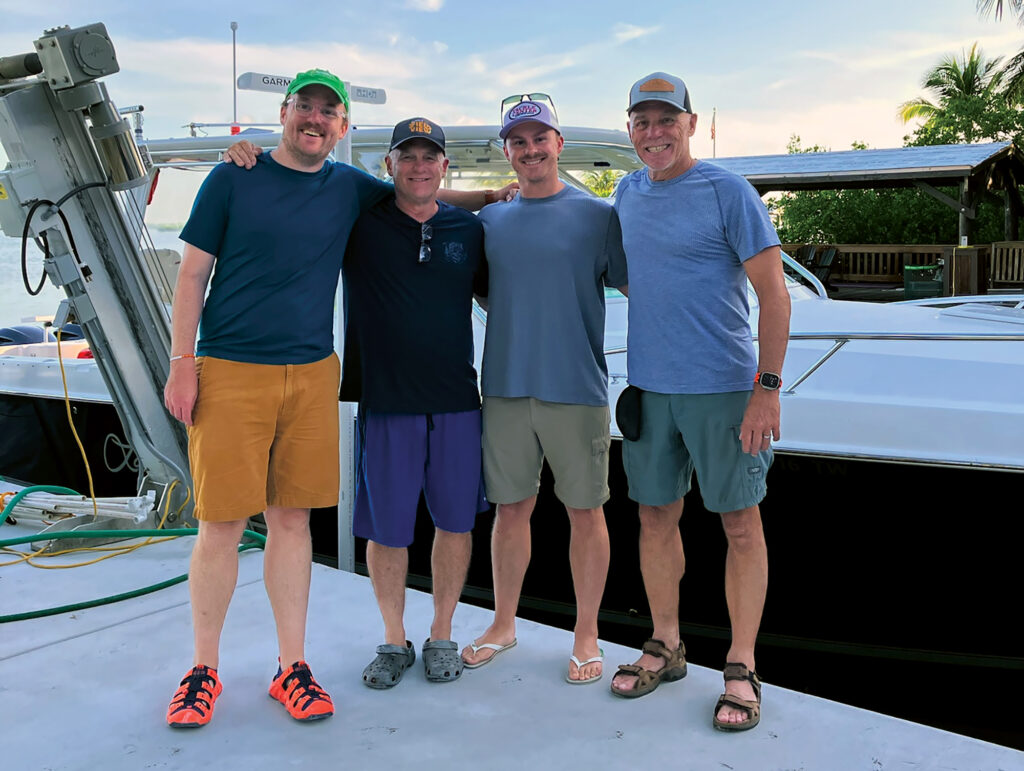
It helped that Peter wasn’t alone. He had his sons aboard. His oldest, a professional software engineer, could reprogram an autopilot the way other men re-spooled fishing reels. His younger son had already survived the “mini-loop” with him, proving himself sturdy enough to endure the long haul. Between the three of them, they figured someone would always be awake, someone would always be steering (or at least nudging the autopilot), and someone would always be willing to laugh when things went wrong.
Things, inevitably, did go wrong.
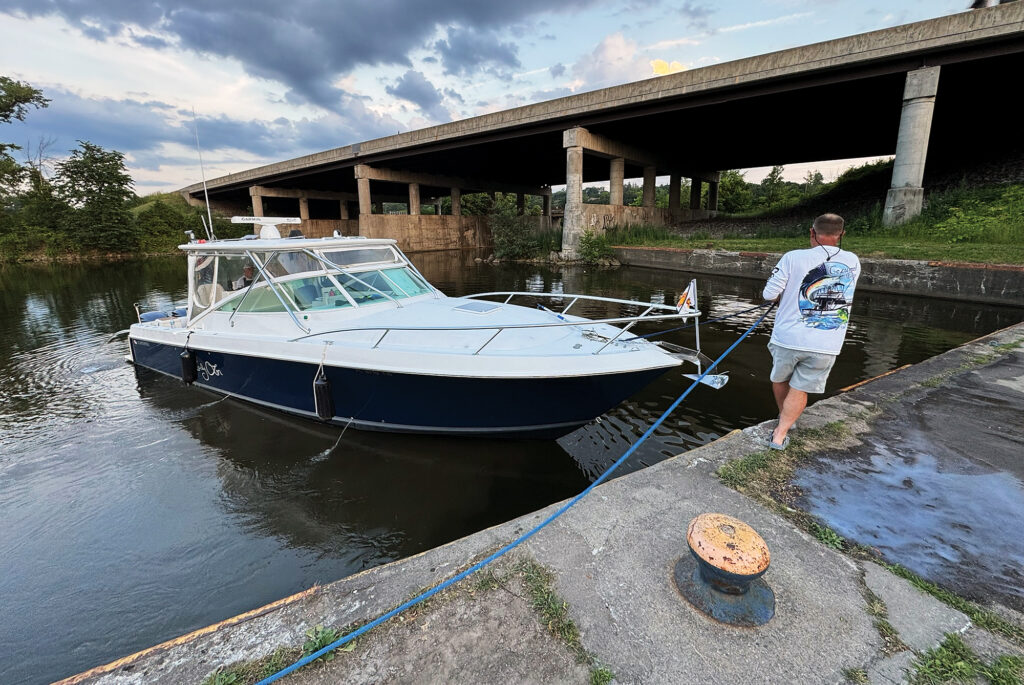
On the Erie Canal, while waiting for a lock, the steering wheel went slack. No drama, no warning, just dead hands on cold stainless steel. “No steering,” Peter said. “Steering wheel’s totally … it’s fly by wire, so it’s a helm unit. And it just gave up.”
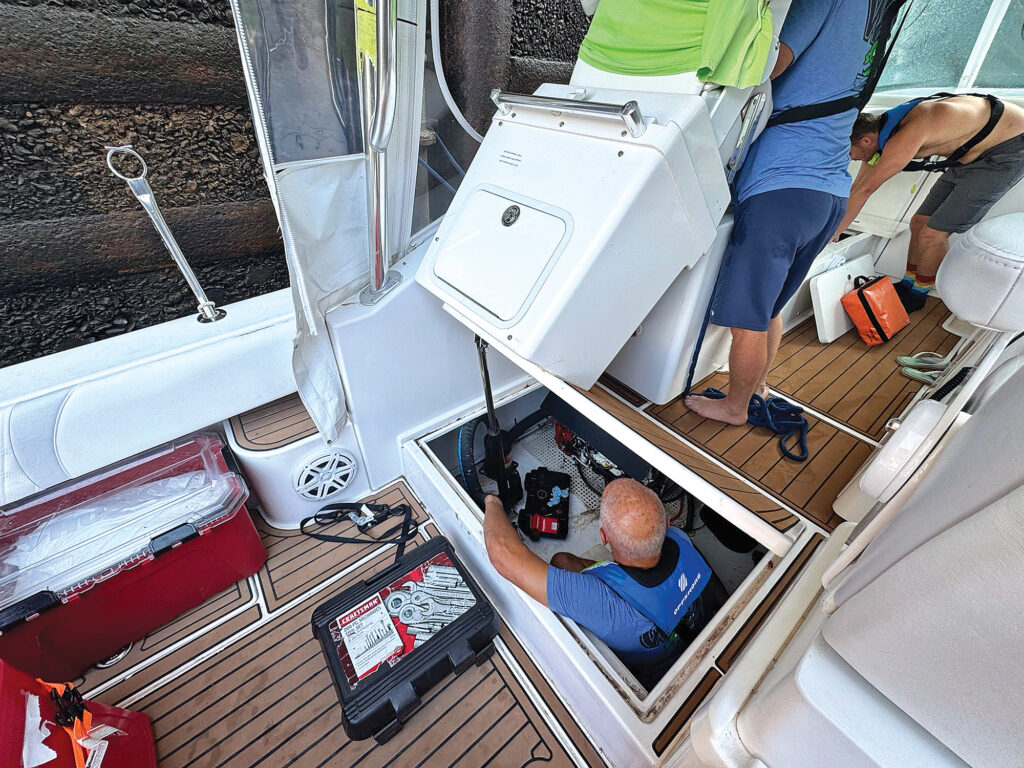
What followed was equal parts mechanical detective work and small-town miracle. Under the helm, in heat that could poach an egg, Peter checked wires with a test light, sweat dripping into his eyes. Diagnosis: bad helm unit. Solution: find a new one, fast. His daughter-in-law located the part in Illinois, shipped it to a stranger he’d once met through the American Great Loop Cruisers Association forum, and—because boating stories are rarely neat—this stranger drove 150 miles to hand-deliver the part at a free dock.
The swap was not simple. Three components of the steering system needed to be re-flashed to match software versions. Cue the family software engineer and a Dometic technician who, in a detail too perfect for fiction, was on a date with his girlfriend when he took their call. “He’s walking my son through a software re-flash at 10:00 at night,” Peter recalled, with equal parts gratitude and disbelief. “He kind of bought into our mission.”
The phrase kept surfacing throughout his telling: bought into our mission. As if the Great Loop itself were less a geographic circuit than a cult of determination, drawing in strangers one by one—the fisherman who tipped them to an early-opening gas station, the southern lock operators who phoned ahead to clear their path, the barge captains on night watch who guided them through the river’s black serpentine turns.
Community, Peter discovered, was not an incidental part of the record. It was the ballast.
Not that competition didn’t play its part. At the same time Peter was circling the Loop, another man was chasing history: seventy-one-year-old Robert Youens, attempting the course in a 16-foot jon boat. If Peter’s Lady Lore was a sleek endurance machine, Youens’ boat was something between a dare and a punchline—an aluminum sliver pushed by stubbornness and sinew. Yet, to Peter, it was never mockery. From their first conversations, the two men bonded, swapping spreadsheets, strategies, and encouragement.
“He’s a superclass guy,” Peter said. “Had we met sooner, I think we would’ve been lifelong friends.”
The respect was mutual. As Peter crossed the finish line, Youens called within the hour to congratulate him—even while still out on the course himself. Their rivalry had the friendly edge of two kids in a science fair, secretly hoping the other kid wins too.
Still, make no mistake: records mattered. When Peter first began toying with the idea, the bar stood at 28 days, set by “Tortuga Steve” Herndon. Manageable, Peter thought. Leisurely, even. But then came Red Flowers, who slashed the time to 19 days and 18 hours. Suddenly, the stakes sharpened. A year-long meander down the Mississippi this was not.
Peter was honest about the escalation. “I’m like, we’re not going to do this and not get the record or not try to get the record.”
That’s how one goes from a dream in Wisconsin to a sleepless sprint around the Loop. From the pontoon his father never launched, to the boat his sons now crewed. From a 28-day record that seemed generous, to 12 days, 18 hours, and 10 minutes—a number that will either stand as a monument to lunacy or be shaved again by someone even more lunatic.
For now, it belongs to Peter Hajas and Lady Lore. And to the people—family, strangers, rivals—who “bought into the mission.”
In boating, the first rule of adventure is simple: things will break. The second rule is crueler: they will break at night, in the rain, with your crew asleep, and a barge the size of Rhode Island bearing down on you.
Peter Hajas understood this in theory. He had raced off-road trucks through the deserts of Baja, where duct tape and stubbornness kept engines together. He had logged countless hours on Midwestern lakes, where “breakdown” meant a paddle home and maybe a flat of beer in apology. But the Great Loop? That was a different kind of wilderness.
His crew was equal parts family and faith. His sons, Peter Jr. and Eric, were math-brained, software-savvy, quick to speak the alien language of marine electronics. His old racing partner, Kevin Selchow, was a farmer by trade, but in the field he was MacGyver with a socket wrench—able to lash together a fix with baling wire, chewing gum, and optimism. “You kind of have to have MacGyver skills,” Peter explained. “And Kevin’s just super handy. He could fix most stuff or figure out how to Scotch Tape something together if we needed to.”
The “needed to” arrived immediately.
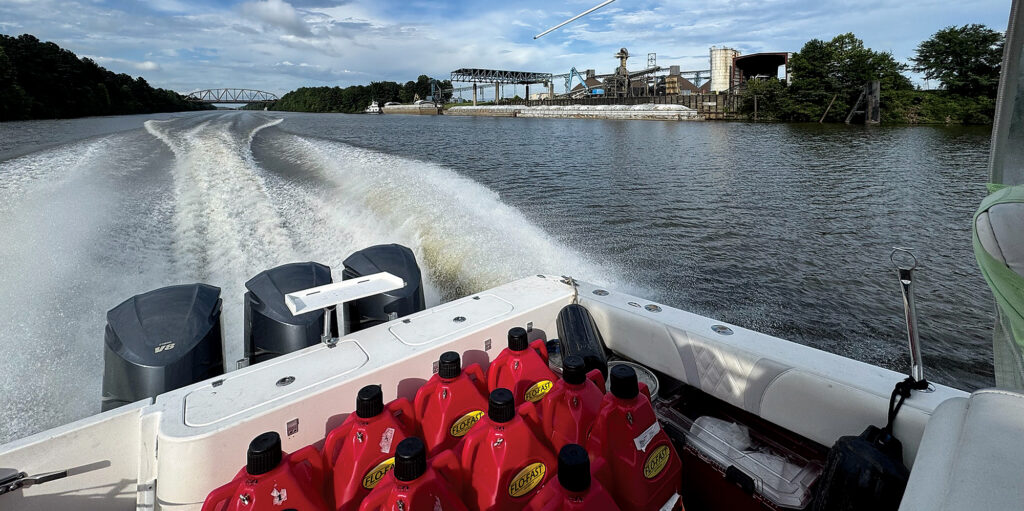
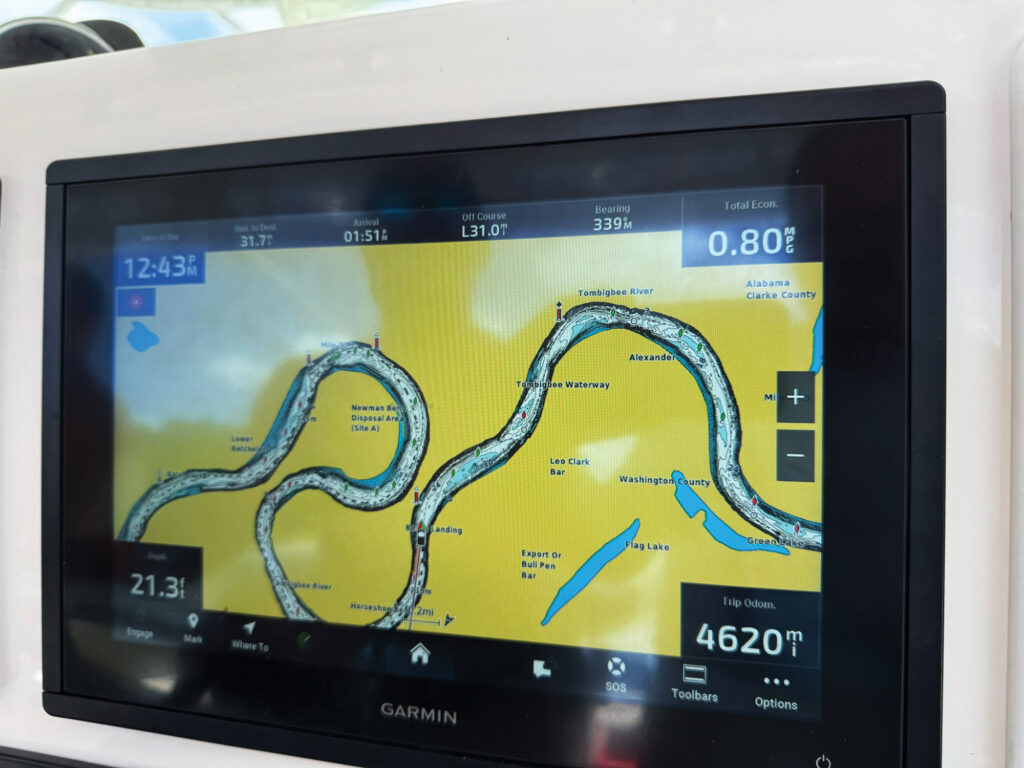
Mere moments onto the Mississippi, they clipped a submerged concrete pier and smoked a prop. “Three minutes in, and boom,” Peter said. Not long after, at 36 knots, the GPS showed 9 feet of water. In reality, it was less than 2. The boat came to a dead stop, grounded hard. “I get out, and I’m standing in a foot and a half of muck and rocks,” he said. The two men not on watch—his older son, Peter Jr., and Kevin—slept through the impact, so exhausted they didn’t stir. Meanwhile, Peter was on the radio, trying to raise BoatUS, who casually informed him they could maybe get there around 10 a.m. The Loop was turning into a waiting game.
But fate, in this case, had a sense of humor. A barge passed, its propellers churning up six-foot swells, and the grounded boat shuddered loose. Peter seized the chance, dropped the outer two engines into the water, and goosed the throttles. They clawed free, props chewing sand, engines screaming, hull dragging for 200 feet until the depth gauge finally showed relief. The Loop had given them a warning shot: Respect me, or else.
The consequences lingered. The bent shaft on the center engine held for another 700 miles before surrendering in a cloud of noise near Mobile. From then on, they limped on two engines, dragging weight forward to coax the boat onto plane. Imagine a grown man, a farmer, and two software engineers sleeping at the bow like ballast sacks so their father could squeeze 20 knots from a crippled Contender. It worked—but it cost them 30 hours, which in record terms might as well be 30 years.
The breakdowns didn’t stop there.
Day one, offshore from Jacksonville, a storm rose as if scripted by Poseidon himself. “We’re probably 70 miles offshore,” Peter said, “and it’s getting dark. Then the weather looks dicey, and two of the guys are just super sick—vomiting off the back. Me and my other son were almost on the verge.” The waves grew to 8 feet, and the Contender pounded, slamming through them like a stubborn mule. The trip, he realized, might end before it began. “This trip is trying to make us check out on day one.”
Instead, they bailed for Bald Head, North Carolina. They slept an hour. They pressed on.
Sleep, or the absence of it, became the true antagonist. There was no tidy watch schedule, no tidy logbook with shifts neatly marked. Instead, it was survival rotation: whoever could pry open their eyelids, drove. Whoever was fading, curled up in one of four narrow berths below. “If you can’t keep your eyes open, wake the other guy up,” Peter explained. And so the nights blurred—two men at the helm, two men in unconscious collapse, all four of them increasingly hollow-eyed and strange.
The strangeness extended below decks, too. The boat had a shower, but they never used it. A head, but never flushed it. Showers came at marinas or in the river, improvised with hoses and PVC contraptions. Baths meant jumping off the swim platform, soaping in muddy water, clambering back aboard refreshed but mosquito-bitten. They never once pumped out. To a cruiser, that might sound barbaric. To a racer, it was streamlined efficiency.
And then there was the food.
“Remember Cortez?” Peter told his crew before departure. “When he got to South America, he burned the boats? Well, guess what—I’m burning the boats. We’re only bringing twelve days of food. We either do this in 12 days, or we don’t eat.”
The food, such as it was, could generously be described as Spartan. Pre-peeled hard-boiled eggs. Cans of tuna. Vacuum-packed steaks. Packaged bacon. “Meat missiles” of cheese sticks wrapped in prosciutto. A month before departure, Peter had convinced the entire crew to join him—temporarily, at least—in his 6-year stint as a strict carnivore. No bread, no fruit, no vegetables. Just protein. Lots of it.
And then, as soon as the trip began, nobody wanted to eat.
Storms, exhaustion, and seasickness blunted every appetite. The crew lost weight by the day. “We came home with probably seventy percent of the food,” Peter admitted. The Omaha steaks, the tuna, the eggs—they all rode the Loop unopened. They’d planned for twelve days of hearty feasting; instead, they gnashed through sleep deprivation, their brains whispering that calories could wait. “Your bigger problem is not sleeping,” Peter explained. “Figure that out, and then worry about food.”
When they did eat, it was often absurdly redundant. At one fuel dock, they ordered bacon cheeseburgers—despite the freezers already stuffed with bacon and beef. “You already had beef and bacon on the boat,” I found myself almost admonishing Hajas. He just laughed. What’s one more patty when you’re chasing history?
Yet amid the exhaustion and absurdities, there were moments of grace. Passing through downtown Chicago at midnight, the city lights danced off the river, glass and steel canyons rising on both sides. For Peter, who had once walked those bridges on his commute as a young man, the return by water was dreamlike. Later, on Kentucky Lake and the Tennessee waterways, the sheer beauty stopped him cold. “It’s like paradise,” he said, marveling at the hidden coves and houses perched along what felt like private kingdoms of river.
The Loop gave its gifts stingily. To earn them, you had to endure the grinding middle: the bent props, the sleepless nights, the unrelenting fuel stops, the gnaw of uncertainty every time you throttled forward. But for Peter Hajas and his oddball crew those gifts were worth it.
If the Loop was mostly noise, vibration, and exhaustion, it also had moments of sudden beauty that slipped through the cracks like light through blinds.
The Tennessee River system stunned him most: Kentucky Lake, Barkley, and the string of reservoirs that shimmer like hidden jewels. “It’s just really beautiful,” Peter recalled. “The terrain was very different, super, super beautiful.” The Loop has a way of humbling even seasoned racers; a man who has thundered across deserts at a hundred miles an hour found himself in awe of mirror-flat water and tree-lined banks.
The Erie Canal, too, forced a pause. By then the crew was impatient, chewing the days like jerky—of which there was also plenty aboard—desperate to press the throttles forward. Juxtaposing the racers on the Canal were summer families strolling riverside promenades, kids licking ice cream cones, cafe lights twinkling in tourist towns, through which the Contender passed like a bullet in a glass museum. For a moment, Peter admitted, it would have been nice to stop, tie up, and sit under an umbrella with a cold beer. But records don’t wait for lattes and stroller parades.
Not all the memories were picturesque. Northern Lake Michigan gave them a hard beating as its north-south winds are wont to do. And then came the moment that froze Peter’s heart. His son—grown, 35 years old, strong—slammed his head and staggered, confused, not knowing where he was. “I hadn’t seen that look in his eyes since he was 9 years old,” Peter said quietly. “There was this fear-based confusion, and I saw a little boy again. It scared the hell out of me.”
They debated diverting for medical help. Wisconsin lay hours off to port, Chicago hours ahead. They pressed on toward the city, watching him closely. He recovered, slowly, and insisted they continue. But for Peter, a father first and a racer second, that hour left a scar deeper than bent shafts or shredded impellers. “That was very, very scary,” he said.
The Loop is billed as a gentleman’s cruise, a retirement fantasy of pastel towns and leisurely locks. But for the Hajas crew, it was closer to combat—equal parts grace and terror, laughter, and fear.
When the fuel pumps finally clicked off for the last time, the numbers read like something out of a fever dream: 12 days, 18 hours, 10 minutes. A new record, set not by a polished professional campaign but by what Peter calls “a hobby team.”
In the weeks since, he has begun to digest it all. The soreness has faded, the exhaustion has lifted, and the memories are hardening into something he can hold. “I think the more time I get between the end of the trip and now, the better the memories are,” he said. “It was intense. Pain was intense.” But pain is almost amnesiac. Almost.
Asked if he would try again, he shakes his head. Once was enough. The record will likely stand for years, unless someone with offshore fuel tenders and deep pockets takes a run at it. “Someone’s got to get super professional to beat it,” he said. “We were just a hobby team.”
What’s next? Something slower, gentler, warmer. “Next time, I want to maybe explore the Bahamas with my family,” Peter mused. “It’ll be at a much more relaxed pace. We’re not going to beat ourselves up.”
As for the boat—a bruised, if loyal Contender—it may stay another year. With grandchildren to think of, an air-conditioned cabin has its appeal. From a fishing perspective, it’s no walkaround, but it’s safe, steady, and after surviving the Loop, it deserves a retirement in the islands. “It was the right kind of boat for this trip,” Peter said. “We beat the hell out of it, but it did the job.”
The racer in him, though, can’t help but assess the hardware. The Yamahas, 350 V8s, ran like stallions, turning 5,000 rpm for nearly two weeks straight. He talks about repowering with newer, lighter models, about repairs and replacements. Even at rest, his mind is always building the next machine.
That instinct comes from a lifetime in motion. Before boats, there were Baja trucks and Dakar buggies, races that carried him across deserts and continents. He has won the Baja 500, the King of the Hammers, and even raced coast-to-coast across South America. “I was in professional classes,” he said simply, as if driving 500 horsepower through dunes was no more unusual than mowing the lawn. He won championships. He earned sponsors. He was once a face in BFG commercials, his car a cameo in video games.
But he has also broken bones, lost teeth, and buried friends. At 65, he is the oldest man still racing as hard as he does, lining up against teenagers backed by Monster Energy contracts. He knows the cost. He also knows the pull. “There were a couple years there when I was winning championships,” he said. “Now my kids are getting excited about it. But you do start thinking about risk.”
Between racing and finance—his other life, the one in quantitative trading firms and hedge funds—Peter has lived at speed for decades. He built businesses, sold them to banks, ran his own family office. Free time was earned, not given. The Loop was in some ways a culmination, in others a proof-of-concept: that a race course—whatever the medium—could still surprise him, still test him, still humble him.
The record may fall one day … but this record, Peter’s record, is the one set by a family, a farmer, and a stubborn man who has spent his whole life chasing the horizon.
As he put it: “It was a cool trip. Very intense. Hard to appreciate unless you’ve done it.”
And maybe that’s the essence of Peter Hajas—intensity, tempered with humor, carried through exhaustion, rewarded in memory.
Listen to our conversation with Peter Hajas here >>
This article originally appeared in the December 2025 issue of Power & Motoryacht magazine.